Welcome to a field guide for street art play, a practical, step-by-step way to bring creative games, chalk murals, and collaborative mini-installations into sidewalks, plazas, and courtyards without turning public space into a mess or a nuisance. If you have ever wanted to invite neighbors to scribble, hop, draw, puzzle, and improvise together right outside their doors, street art play gives you a safe, joyful framework to do it.
Why play belongs in the street
Public space is the original commons. When an activity feels open, shared, and spontaneous, people who do not know each other can still make something together. Play is one of the most accessible ways to spark that dynamic, because it lowers the threshold for participation. Nobody needs an invitation to draw a line of chalk or to jump the squares of a hopscotch. That spirit is why a small, well-planned action can reset how people see their own block, even if it lasts only the afternoon.
The promise is simple: short, low-cost, repeatable moments of co-creation that turn passersby into collaborators. Street games and quick art prompts are forgiving. They welcome imperfect lines, off-beat rhythms, and unexpected choices. Because the stakes are low, people who would never sign up for a workshop will still pause to add a doodle, pose for a photo, or try a round of a game they have not played since childhood.
Public play also builds practical community “muscle.” When neighbors co-author something in a shared place, they practice how to ask for permission, how to coordinate, how to set boundaries, and how to clean up. Those behavior patterns matter more than any one drawing or scoreboard. Over time, a pocket of collaborative energy can transform a corner that used to be ignored.
Finally, play is self-explanatory. You can see it from a distance; you can decide to join in seconds; you can leave without ceremony. The format respects busy lives and competing priorities. People get a taste of creativity in transit. And that taste often makes them want another.
What is street art play?
Street art play blends prompt-based creativity with light, inclusive game mechanics. It uses simple materials—chalk, painter’s tape, removable dots, string, recycled cardboard, sidewalk-safe crayons—and pairs them with rules so minimal you can explain them in one sentence. The result lives somewhere between a chalk mural, a puzzle, and a micro-festival. It invites all ages, assumes limited attention spans, and thrives on curiosity.
Think of it as three ingredients that you combine in different ratios depending on the setting:
- Prompts: Short invitations to act. For example, “Draw the sound you hear right now,” or “Trace your shoe and turn it into a creature,” or “Connect two dots with a curve.” The prompt sets the tone and helps shy people begin.
- Game frames: Light rules that offer a goal, a turn order, or a challenge. For example, “Add one line, then give your chalk to someone new,” or “Follow the blue tape without stepping off,” or “Roll a die to pick a color.” The game frame keeps things moving and gently discourages dominant personalities from taking over.
- Place cues: The way the site itself shapes behavior—shade and wind, slopes and steps, sightlines and bottlenecks, seating, noise, and thresholds. A wide plaza tolerates bigger gestures; a narrow sidewalk rewards quick, linear prompts. Respecting the site makes success feel effortless.
In practice, the “art” and the “play” overlap. A chalk constellation doubles as a target for beanbags. A tape maze becomes a route for scooter kids. A giant color wheel chalked on the pavement becomes a place to stand when meeting someone, then a backdrop for photos, then a collaborative coloring page.
Because the format is modular, a single afternoon can include quick rotating stations—five minutes each—so participants return often and feel like every visit offers something new.
How to start street art play in your neighborhood
If you are just beginning, keep your ambition small and your feedback loops short. Pilot with eight to ten neighbors. Give yourself a short set-up and a short takedown. Tailor your plan to the block, then iterate the design the next time you run it. Here is a pragmatic five-step path that works well for first-timers.
Step 1: Walk the site with fresh eyes. Visit at the same day and time as your intended event. Count pedestrians and note where they slow down. Identify shade, water access, and the nearest trash bin. Sketch the ground conditions—smooth concrete, pavers, or asphalt—and photograph slopes, drains, and curb cuts. Your map will become your station plan.
Step 2: Choose a micro-format. Pick two or three tiny activities rather than one giant one. For instance, “chalk postcard” drawings, a tape path, and a hopscotch remix. If a station attracts too big a crowd, the others provide an overflow. If a station flops, you still have two that succeed. A small menu also protects your energy.
Step 3: Draft a one-page playbook. Write one sentence per station describing goal, materials, and a 15-second instruction. Add a sketch. Include a plan for a friendly “host” at each station and a line that signals how someone ends their turn. This removes ambiguity and lowers anxiety for both newcomers and helpers.
Step 4: Ask permission and meet the guardrails. Many cities allow chalk and temporary tape if you clean up the same day, but rules differ. If it is a sidewalk, talk with adjacent property stewards; if it is a plaza, find the operator; if it is a cul-de-sac, ask the neighbors. Keep your ask simple, explain clean-up, and share a phone number. Be a good guest.
Step 5: Recruit two co-hosts. One person engages passersby with warm invitations; another maintains supplies and safety. If you cannot recruit, streamline your plan until you can run it alone. A tidy activity with one host beats a sprawling one that feels chaotic.
Legal, ethical, and neighborly basics
Public play prospers where trust does. You rarely need a stack of paperwork, but you always need courtesy. Before you chalk the first line, make sure you have considered what is appropriate for the space and the people around it.
- Permissions: Sidewalk chalk and painter’s tape usually do not require formal permits when cleaned the same day. Paint, permanent markers, adhesives, and fixtures almost always do. When in doubt, err on the conservative side.
- Clean-up commitments: Plan to leave the site as you found it, or better. Bring a broom, a water bucket, and trash bags. Assign clean-up roles so departure is smooth rather than frantic.
- Noise and flow: Keep sound low. Keep corridors open. If your format slows foot traffic, move it to the side or design a quick “pass-through” version for people in a hurry.
- Consent and photos: If you photograph participants, ask first; if children are involved, ask their guardians. Post a small sign: “Photos happen here—tell us if you prefer not to be photographed.” Respect the answer.
- Belonging: Plan prompts for different ages, languages, and abilities. Avoid themes that put anyone on the spot. The goal is an easy yes.
Most of all, avoid anything that looks like it could damage surfaces, block entrances, or claim space as yours. A street is not a blank canvas; it is a shared, negotiated field. You want property stewards to see your group as the neighbor who cleans up after the picnic—not the one who leaves glitter in the hedge.
Materials and tools that work
Street art play succeeds or fails with humble supplies. Use items that are inexpensive, durable enough for repeated use, and easy to clean. The shopping list below has been refined by many neighborhood events; modify it for your climate and ground type.
- Chalk: Fat sticks are easier for small hands; dustless chalk reduces mess; wet chalk becomes paint for vibrant areas. Keep colors simple: white, yellow, blue, red, green. Label a bag for broken bits that still draw boldly.
- Painter’s tape: Choose low-tack tape that lifts cleanly. Two widths—thin for lines, wide for borders—cover most needs. Avoid duct tape; it leaves residue and can trip people when it peels.
- Removable dots: Vinyl dots or masking dots mark starting points, lanes, and targets. They peel without damage and help you create layouts fast.
- String and clips: Chalk lines and string arcs let you compose circles and curves without measuring.
- Recycled cardboard: Cut into stencils, arrows, and letters. They form consistent icons and reduce decision fatigue for shy participants.
- Portable caddy: A cheap toolbox or milk crate keeps chalk, tape, scissors, wipes, and cards within arm’s reach. Small bins prevent supply scattering.
- Cleaning kit: Soft broom, water bucket, rags, biodegradable soap. A few liters of water erase most chalk quickly; tape and dots come up by hand.
Make each station self-sufficient. Place a mini caddy at each spot so people do not queue for supplies. Refill from a master caddy you keep by your chair.
Game formats: proven activities you can run tomorrow
Below is a toolbox of formats that consistently attract passersby. Each one explains itself in seconds, scales up or down, and ends cleanly so new people can join. Use the variants to keep regulars engaged over multiple sessions.
1) Chalk postcards. Draw a rectangle about the size of a postcard. Write “To:” in the corner. Prompt: “Send a chalk postcard to the block.” Variants: theme days (colors, seasons, animals), “Reply to a postcard you like,” or “Add one detail to an existing postcard.” Clean-up: rinse the grid lines; leave the images if that is acceptable on your street.
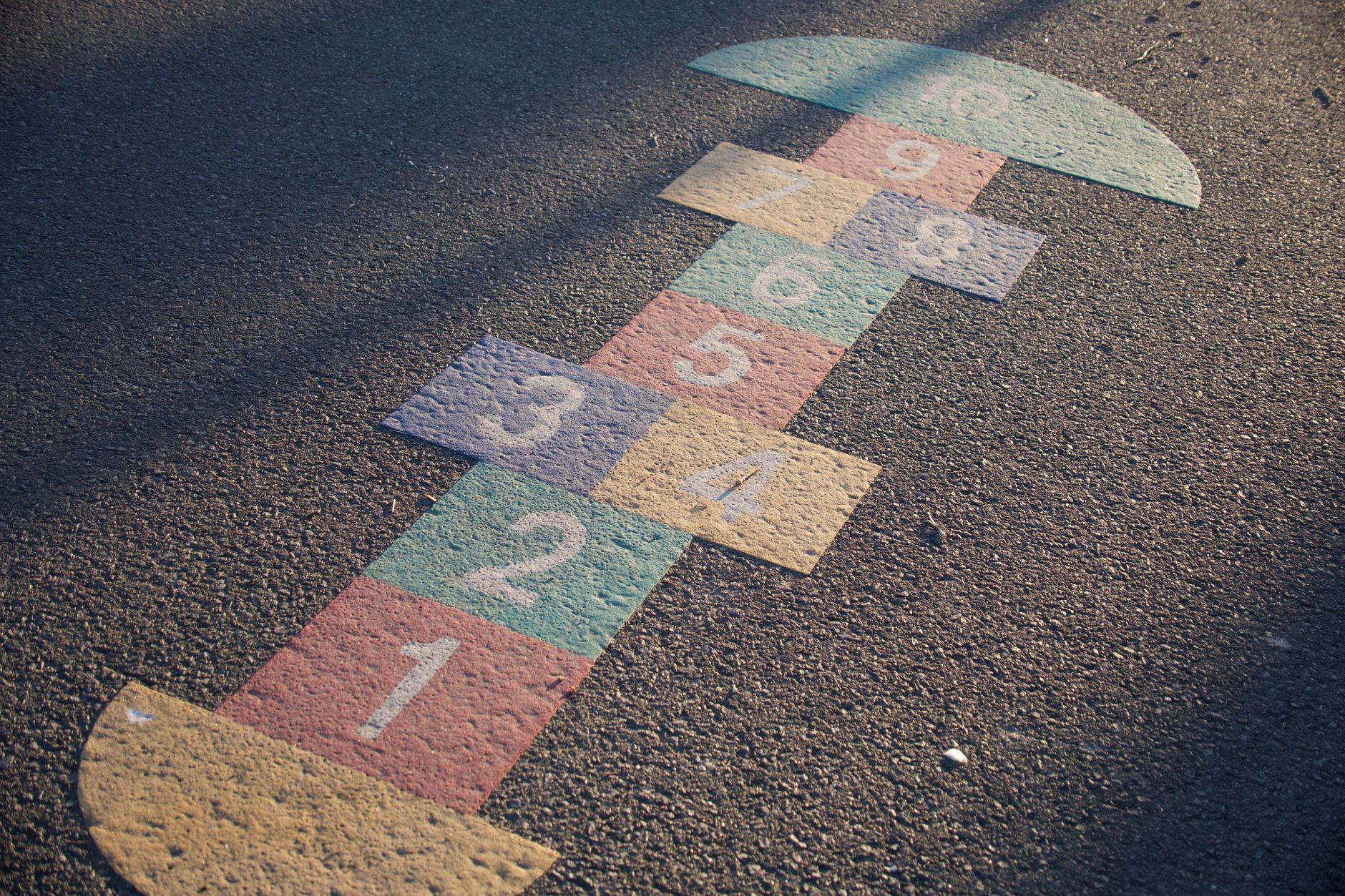
2) Hopscotch remixes. Replace numbers with symbols (sun, wave, leaf). Prompt: “Jump the sequence your friend calls.” Variants: cooperative mode (two people step together), memory mode (add one symbol each turn), or agility mode (use diagonal squares). Clean-up: lift tape numbers and sweep chalk.
3) Walk-the-line tape paths. Lay a curving tape line with branches. Prompt: “Stay on the tape; do not step off.” Variants: speed run, backwards walk, balance an object, or add “pause circles” where players freeze and pose. Clean-up: peel tape back on itself to avoid residue.
4) Connect-the-dots constellations. Scatter removable dots; assign each a letter or number. Prompt: “Connect two dots with a curve.” Variants: limit each person to one line, require arcs to avoid crossing, or invite people to title the constellation aloud. Clean-up: peel dots, rinse lines.
5) Pattern blocks and stencils. Provide cardboard stencils: triangles, circles, arrows. Prompt: “Compose a repeating pattern along the curb.” Variants: two-color rules, expanding patterns, mirrored patterns. Clean-up: sweep off excess dust.
6) Neighborhood story tiles. Chalk a grid of squares. Prompt: “In one square, draw a tiny scene from your day.” Variants: “Draw a memory,” or “Draw something you hope to see here.” Encourage quick captions for people who prefer words. Clean-up: rinse grid; leave drawings if permitted.
7) Spontaneous parade. Mark a simple loop with tape and arrows. Prompt: “Walk the loop with an object you decorate.” Provide ribbon, paper, or leaves. Variants: instrument parade, quiet parade, slow parade. Clean-up: collect ribbons, peel arrows.
8) Color wheel co-op. Chalk a giant wheel with labeled wedges. Prompt: “Stand on your color; trade places without stepping off the wheel.” Variants: call-and-response, musical colors (start/stop), or “find the complementary color.” Clean-up: rinse wheel segments.
9) Chalk labyrinth. Draw a simple labyrinth path. Prompt: “Walk slowly to the center and back.” Variants: barefoot labyrinth on grass if available, or a finger labyrinth on cardboard for people who cannot walk the big version. Clean-up: rinse chalk gently so curves do not smear into stains.
10) Rolling canvas. Tape a strip of craft paper to the ground near a bench. Prompt: “Add one mark and roll it forward.” Variants: roll-and-draw relay races, stencil-only days. Clean-up: recycle paper; do not leave scraps behind.
Each format stands alone, but they also layer. A connect-the-dots field along a block can feed shapes into the pattern station; story tiles can inspire postcards; the color wheel can anchor the hopscotch remixes. Layering makes a small kit feel abundant without adding cost.
Designing for different spaces
No two sites behave the same. A narrow sidewalk prefers thin, linear formats. A cul-de-sac tolerates loops and stations. A plaza begs for big gestures and multiple clusters. Use the following quick typology to adapt your plan.
- Narrow sidewalks: Go linear. Place tape lines parallel to the curb. Use postcard rectangles against the building edge. Keep prompts that take under thirty seconds to respect pass-through traffic.
- Corner bulbs and bump-outs: Make small loops around seating and planters. Use connect-the-dots on the open side so people can contribute and step back to watch. Post a host here; corners attract.
- Plazas and courtyards: Anchor with a centerpiece (color wheel, labyrinth) and satellite stations around it. Provide at least one bench-side station for people with mobility constraints.
- Shared streets and cul-de-sacs: Consider a parade loop or bicycle-friendly tape path. Communicate with drivers; use cones or chalk signage to signal that a play session is underway.
- Bridges and underpasses: Use bold tape graphics and sturdy dots; wind can disrupt loose paper. Keep prompts audible but gentle; echoes can amplify sound.
Surface matters too. Chalk loves smooth concrete and sulks on rough asphalt. Tape adheres to pavers if they are dry but lifts if the joints are wide. Wet the chalk for saturated color on rough surfaces. Test a small piece of tape on the exact stone; tug to ensure it will not leave residue.
Safety and accessibility
Street play should feel easy and safe for everyone who encounters it, including people who do not wish to participate. Use the following checklist to design sessions that reduce risk and increase inclusion.
- Visibility: Hosts wear bright hats or sashes. A small sign announces the activity and contact number. This signals accountability and invites questions.
- Clear paths: Keep a continuous corridor for passersby. Tape edges of stations to signal boundaries and avoid trip hazards.
- Seating and shade: Offer a stool at each station and one shaded resting area. People who cannot stand long still deserve a full share of play.
- Universal prompts: Use plain language and icons. Avoid specialized jargon. Provide translation on a card if your block uses multiple languages.
- Mobility awareness: Align stations so people using wheelchairs or strollers can reach them. Keep at least one station designed for seated participation.
- Hand hygiene: Provide wipes. Chalk dust is part of the fun; clean hands help people reenter their day.
If anything feels unsafe in the moment—wind gusts tear tape, a station blocks a ramp, a dog is stressed—pause and adjust. Your responsiveness is part of what makes neighbors trust you to host again.
Weather, durability, and clean-up
Weather turns play into improvisation. That is not a problem; it is a design constraint. Plan for sun and wind, drizzle and heat, and a fast exit.
- Wind: Avoid loose paper except the rolling canvas station, which you can tape every foot. Use heavier chalk lines and dots to anchor visuals.
- Sun: Schedule in the morning or late afternoon; bring a shade umbrella for your supply base; rotate stations into shade during the session.
- Drizzle: Wet-chalk becomes paint—use it. If rain falls, switch to a “two-station micro” under awnings, then end early. Clean-up is faster in the rain; chalk melts on its own.
- Heat and cold: Shorten sessions to one hour. Provide water cups, and remind participants they can step out any time. Play should refresh, not exhaust.
Make clean-up part of the fun. Invite late arrivals to help rinse lines and peel dots. People often enjoy seeing the cycle complete. A fast clean-up protects your reputation with nearby residents and property stewards, making it easier to host again.
Hosting and facilitation: how to be a good guide
Good hosting is quiet craft. It is the difference between a pile of supplies and a memorable session. Use these practical habits to make the experience warm, equitable, and resilient.
- Open invitations: A friendly line—“Want to add one mark?”—works better than a pitch. Offer, then let silence do the work. Many people need a moment to decide.
- Timeboxing: Encourage short turns: “One mark, then pass the chalk.” This keeps flow and ensures others get access without policing.
- Celebrate small contributions: Praise a single dot or line as valuable. People return if they feel their first contribution was enough.
- Rotate roles: Hosts trade seats every fifteen minutes. This keeps energy steady and prevents burnout.
- De-escalation: If someone resists a boundary (“I want to leave this tape up”), state your commitment to clean-up and liability. Offer to take their contact and talk later. Do not argue on the curb.
- Gratitude: Thank people as they leave. Attention is the currency of public space; return it generously.
For inspiration, browse examples and resources at Art Havens. Seeing how others frame prompts, station layouts, and clean-up routines can help you choose what to try next.
Documenting, learning, and measuring impact
You do not need a dashboard to know if an afternoon worked, but a few light measures help you tune the format and communicate with partners who may support future sessions.
- Quick counts: Every fifteen minutes, do a headcount of participants and observers. Note which stations draw longer dwell times.
- Prompt cards: If you plan to repeat the event, give out small cards asking two questions: “What did you like?” and “What should we add?” Keep it to one sentence. Collect in a jar.
- Photo ethics: Photograph hands, feet, shadows, and works-in-progress; only photograph faces with consent. Label folders by date and station for easy comparison later.
- After-action notes: Write a 10-minute log: what worked, what failed, what you will change. Keep it honest and specific. These logs become your playbook.
Over time, look for patterns: which prompts help shy participants? which stations create bottlenecks? which surfaces erase cleanly? The answers inform your next design. If you publish a short blog, share both successes and adjustments so other people can learn alongside you.
Case studies and templates you can adapt
Below are three fictionalized, but realistic, composites drawn from many neighborhoods. They show how minimal design decisions matter.
Pocket plaza triad. A small plaza had four benches and a cafe. Hosts ran three stations: postcards along the bench, a connect-the-dots field near the planter, and a tape path around the centerpiece. The connect-the-dots field produced the most dwell time, especially for mixed-age families, while the tape path drew teens on scooters. The cafe appreciated that clean-up left the plaza tidy; the team adjusted the next session to add a “pause circle” for scooter tricks and moved postcards to the shadier side.
Sidewalk ribbon. A narrow commercial street could not spare much space. The hosts installed a 30-meter tape line along the curb with arrows every two meters. A chalk card every five meters offered a tiny prompt: “Draw a curve,” “Add a dot,” “Make a leaf.” People treated it like a visual footnote to their errands. The key was the thin format; it never blocked anyone, and shopkeepers praised the courtesy.
Cul-de-sac parade. A residential cul-de-sac hosted a spontaneous parade loop with craft paper streamers and chalk crowns. Kids led; adults followed; neighbors watched from folding chairs. Because clean-up was clear—streamers collected, chalk rinsed—residents asked to repeat it monthly. The parade station became a signature activity for the block.
To adapt these quickly, write mini checklists on index cards and tuck them into your caddy. Here is a simple template set:
- Set-up: Arrive 20 minutes early. Walk the site. Lay tape and dots. Stage caddies at stations. Don hats or sashes.
- Host brief: Share 15-second instructions for each station, plus a boundary line and a pass-the-chalk rule. Confirm clean-up partners.
- Session flow: Start with postcards to warm up early participants; open tape path when more kids arrive; rotate hosts every 15 minutes; invite photographers to share images after consent.
- Clean-up: Begin 10 minutes before end. Peel tape, collect dots, sweep chalk dust, rinse lines with minimal water, double-check for residue, thank nearby neighbors.
From pop-up to pattern: building a small program
Once you have run two or three sessions, you will likely feel a pattern emerge. You know where shade falls, which prompts spark repeat visits, and how long your energy lasts. Consider formalizing a simple rhythm so people can anticipate future play.
Pick a cadence that respects volunteers. A monthly session can be easier than weekly. Share dates on a paper flyer and a simple web page. Invite neighbors to adopt a station. Keep a public checklist so new helpers can step in without a long briefing. Over time, your street can host an informal “season” of micro-festivals that remain light on logistics.
You can also form gentle partnerships. A cafe might provide water; a library may loan stencils; a school art class could propose prompts. Keep agreements simple and reversible. The point is to keep the activity nimble, not to build heavy commitments that drain joy.
Most important, keep learning. A place changes with seasons, construction, and the moods of people who cross it. When you return often with curiosity, you build a culture more than an event—a culture where people expect to add a dot, draw a leaf, or try the tape line for a minute before they move on.
Frequently asked questions about street art play
Is this allowed? In many places, yes—if you use removable, washable materials and leave the site clean the same day. Always check local norms and ask adjacent stewards. Keep formats clearly temporary.
What if someone draws something inappropriate? Hosts set the tone. If a drawing violates community norms, gently rinse it away and invite a different contribution. Keep prompts specific and positive; specificity reduces unwanted content.
How do I involve older adults? Provide seated stations with larger chalk and easy-grip tools. Invite memory prompts (story tiles) and pattern-making that rewards steady hands more than speed. Place these stations in shade.
What about cost? A starter kit can be assembled for a modest budget: chalk, painter’s tape, dots, string, and a broom. Reuse stencils and caddies for many sessions. Invite neighbors to donate chalk boxes; label and store them together.
Will chalk stain? On smooth concrete, chalk rinses easily. On rough asphalt, wet chalk can lodge in pits; use light colors and rinse promptly. Always test a small patch out of the way before a big drawing.
Can I combine art play with music? Soft, acoustic music can be lovely; keep it low, and never block conversation. Many people prefer the natural soundtrack of the street.
A closing nudge
The world is full of heavy lifts that require big budgets, long timelines, and formal approvals. Street art play is not one of them. It is intentionally small, neighborly, and reversible. It respects the ground it uses and the people it meets. It leaves behind good stories and clean pavement. If you try one tiny session this month—one tape line, one constellation of dots—you may discover that your block already has the creativity it needs, waiting for an invitation.